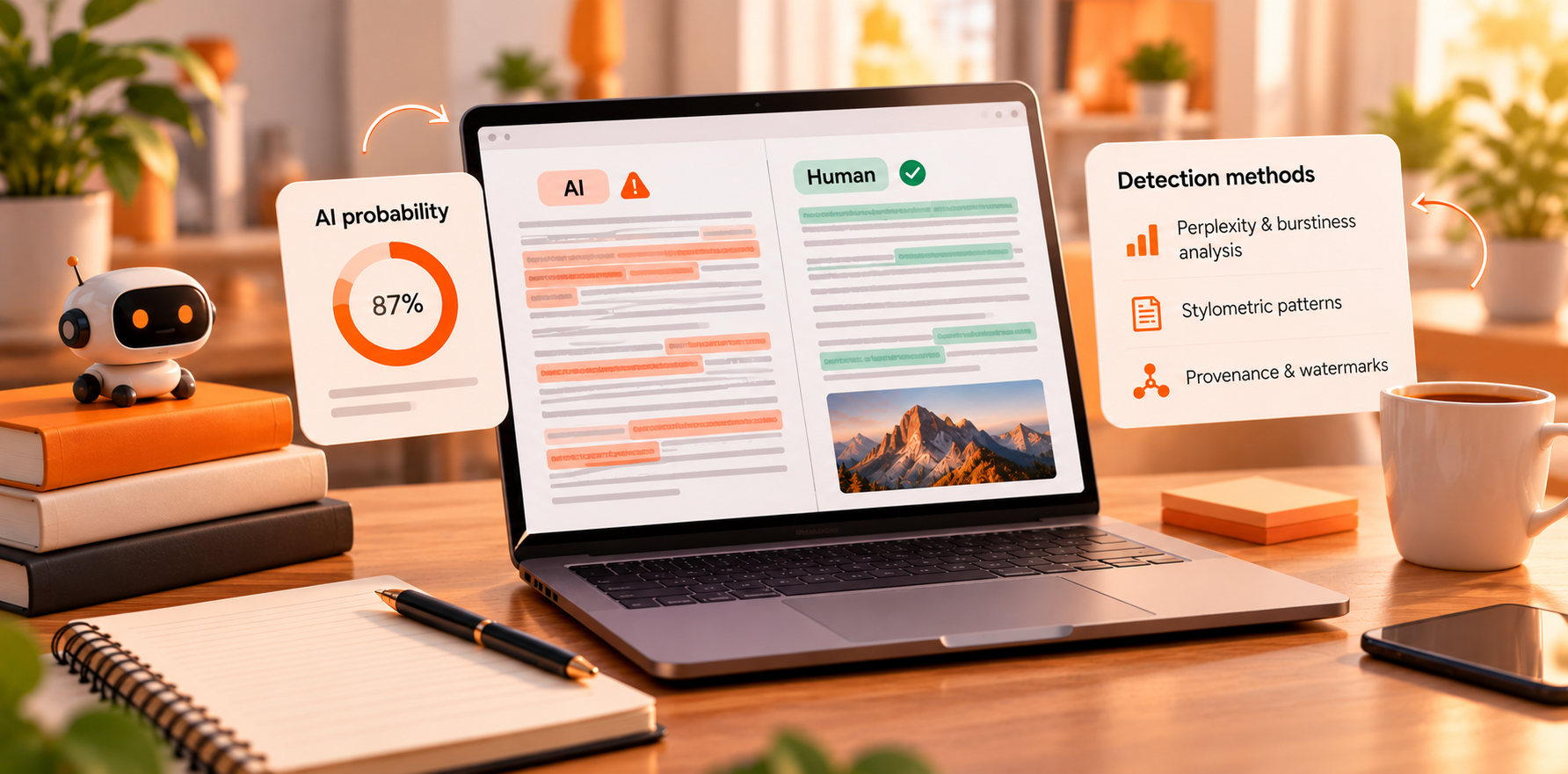
With the widespread use of Gemini, ChatGPT, and Claude, over 70% of new web pages in SERPs contain AI-generated content. However, undermined expertise, compromised academic integrity, and ruined brand trust are just a few of the troubles caused by the excessive use of AI and AI humanizers.
Clicksy’s practice proves that even recent Google updates and advanced detection tools cannot fully resolve the problem. Specialized software designed to check AI-generated content assesses linguistic and structural regularities typical of artificial intelligence. However, even the leading solutions reach only 99% accuracy and fail in some cases.
Clicksy specialists have practical experience with AI detectors and are ready to share their findings with other experts in related fields.
Main Highlights
- AI detectors with a three-tier analysis help find out if the text is human-written or generated.
- Services to detect AI-generated content are used by content moderators, media specialists, and other professionals to check the material authenticity.
- AI checkers become powerful tools for content verification only when combined with other techniques.
- Both AI models and detectors evolve. As a result, new methods to generate AI texts and avoid such a label appear.
Insufficient Verification Accuracy
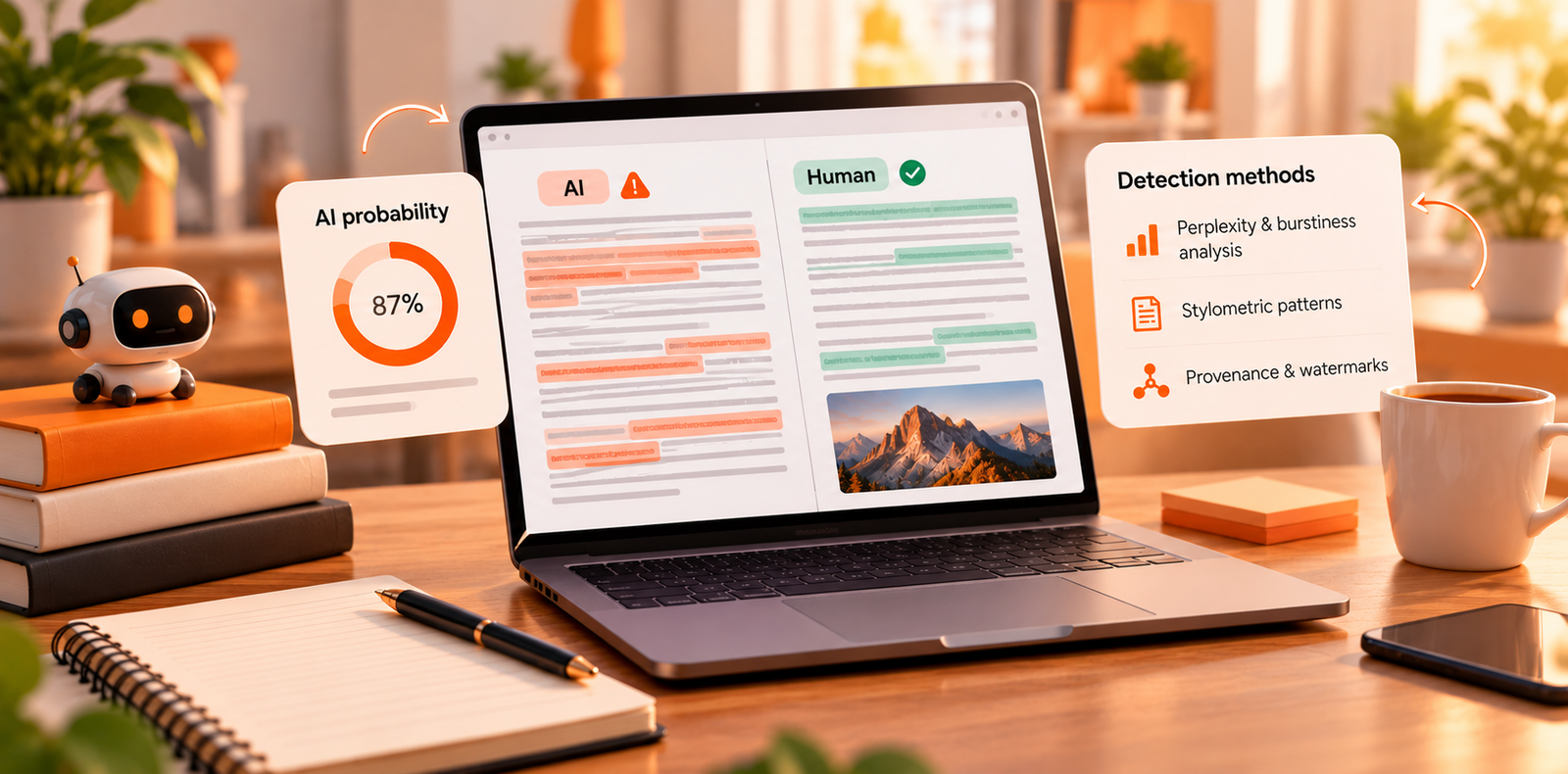
The identification process has three signals – statistical (burstiness, perplexity score), stylometric (language tone and complexity, repetitions), and provenance (watermarks). However, even systems including them all often struggle to distinguish between human and AI-generated content:
- The best tools can give 99% scores to pure AI content.
- If the AI text was paraphrased or refined by an AI humanizer, detection accuracy drops to 30–70%.
- Non-native English writers face higher false positive rates even on premium checkers.
- For a more accurate assessment, the document’s drafts and version history must be verified.
💡Clicksy offers a multistep verification process including human assessment and editing. It ensures a 99% pass rate on the Helpful Content Update test.
What Is AI-Generated Content?
AI-generated content is HTML files, articles, images, audio, video, and other materials produced by a specific model. In copywriting, AI-generated content refers to texts created by large language models (LLMs), such as GPT-6 and Gemini.
We distinguish between completely AI-generated, AI-assisted, and AI-refined content. Unlike 100% AI work, AI-assisted content is mainly drafted by AI and then humanized. AI-refined content is created by a human and then improved by AI.
The less human involvement there is, the faster and easier content creation becomes. This explains why using AI-generated content in marketing, media, and similar areas is growing. However, Google has already started taking penalties against sites that abuse AI-produced texts.
How Google Detects AI Content in 2026
Google can detect AI content but ranks such articles high only if they meet its E-E-A-T requirements, which is impossible without deep human editing. The 2026 updates declare that inappropriate AI content is inadmissible, and Google aggressively demotes it.
You may try to use hybrid content, AI-assisted or AI-refined texts, since its detection is still a hard task for checkers. However, human writing remains the safest way to reach good ranking positions.
How Do AI Content Detectors Work?
An AI content detector works as a machine learning classifier, trained on large volumes of human and generated writing patterns. The dividing line lies between original human thinking and AI writing with typical structures and no personal experience. Overall, AI content detectors look for stylistic, lexical, structural, and classification patterns specific to certain models. However, the overall score is based on statistics, and you should take it as a certain probability instead of a precise assessment.
What Is Perplexity and Burstiness Analysis?
To better understand the basics of AI-generated content detection, you need to familiarize yourself with the terms of perplexity and burstiness.
| Metric | What It Measures | Typical Human Writing | Typical AI Writing |
| Perplexity | How predictable the word choices and sentence structure are | More varied due to individual reasoning and writing style | More predictable because language models favor statistically likely word sequences |
| Burstiness | Variation in sentence length and structures | A natural mix of short, medium, and long constructions creates an uneven rhythm | More uniform sentence lengths and consistent structure |
Perplexity is a language model predictability measure. Low perplexity in AI-generated documents is indicated by obvious word choices, banal phrasing, and plain sentence structures. For example, even beginners notice phrases like “that was a breath of fresh air”, “in today’s digital landscape”, or “a testament to” and qualify them as AI markers.
Burstiness in AI content detection is a metric that shows how variable the text is in terms of simple short and long complex sentences. Humans tend to combine them unintentionally, while AI tools generate template phrases. A detection tool also analyzes rhythm and the use of emphatic word combinations.
What Stylometric and Linguistic Patterns Do AI Detectors Analyze?
Stylometry is another core technique used by classifiers. Here are the stylometric analysis points that AI content detectors look for:
- Function-word allocation.
- Sentence-structure patterns.
- Frequency of repetitions.
- Transitional phrases.
- Overall syntactic complexity.
Human-written speech is variable, while LLMs tend to start with template phrases. They overuse hackneyed expressions, such as “in the realm of,” “play a crucial role,” and “delve into.”
Furthermore, uniformity and diversity analysis at sentence and token levels also show generated content. These metrics are used by advanced transformer classifiers, such as Originality.ai and Pangram.
How Do Watermarking and Classifier-Based Detection Methods Work?
LLMs insert special signals, watermarks, into generated text. For example, Claude’s and ChatGPT’s word choice and stylistic device use are slightly adjusted, creating statistical patterns visible for checkers. AI content is detected by these metadata markers only if they cooperate with the corresponding AI and have access to its keys. Another approach is to apply supervised classifiers trained on labeled corpora, including AI Logic. Compare both:
| Detection Method | How It Works | Main Strength | Main Limitation |
| Watermarking detection | Finds specific anomalies in word selection, intentionally embedded within AI-generated content | Can reliably identify content when watermark data and detection keys are available | Easily disrupted by heavy paraphrasing, formatting changes, or models with no watermarking |
| Classifier-based detection | Uses machine learning models to analyze writing patterns, language features, and statistical signals | Works across different AI models and does not depend on embedded metadata | Accuracy decreases on heavily edited, humanized, or hybrid human-AI content |
Hybrid detectors that implement both are the most effective. Deep paraphrasing and removing hidden formatting are effective ways to remove the AI-generated content watermark. Thus this approach is still fragile if used alone.
How to Spot AI-Generated Content Manually: Signs to Look for
To tell if the content is AI-generated, an editor can analyze it manually. Most researchers note the following specific features of AI-written texts:
- Sentence rhythm. Sentence length and complexity are approximately the same.
- Introductions. AI models use generic and broad patterns, changing only a few words.
- Transitions. Generic text is riddled with transitional phrases.
- Personal experience. AI models meticulously bypass details which could indicate individual knowledge.
- Citations. LLMs hallucinate, especially when facing a lack of information.
- Vocabulary. Generated texts are characterized by a limited selection of synonyms and formulaic phrasing.
- Repetition. Sentences and phrases with a similar meaning occur frequently and become redundant.
- Overall flow. The text seems formulaic and predictable.
Meanwhile, Clicksy specialists state that authentic human texts are topic-related, present personal opinions and verifiable information. Each author has individual vocabulary and stylistic preferences. Finally, natural texts feature organic, dynamic, and spontaneous flow.
Knowing AI Detectors’ Limits
However, the AI detectors’ efficiency remains limited compared to human experts. The ACL study conducted in 2025 with trained annotators demonstrates that they misclassify only 1 article out of 300. Meanwhile, the accuracy of machine detectors was much lower. Another 2025 study by German scientists Fiedler and Döpke shows that humans slightly outperform software when working on short German texts. This research proves that AI checkers work efficiently only together with human expertise and common sense.
What Are the Top AI Content Detectors in 2026?
Clicksy experts consider the following detectors able to check AI-generated content most effectively:
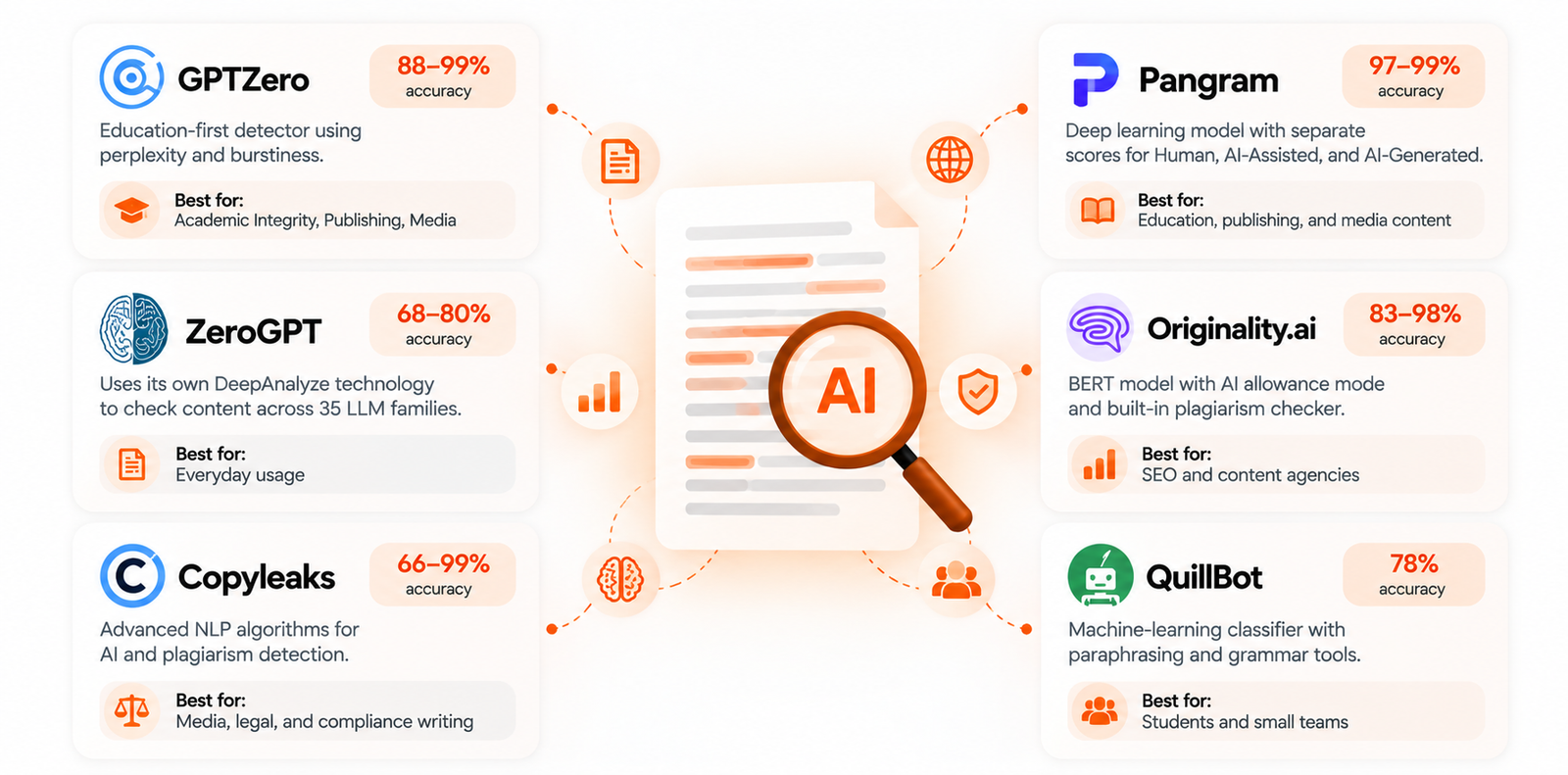
- GPTZero reaches 88–99% accuracy and suits any text type.
- Pangram is 95–99% precise. It is best for education, publishing, and media content.
- ZeroGPT is known for its basic checks. However, its accuracy is only 68–80%.
- Originality.ai, with an 83–98% accuracy rate, has gained popularity among SEO and marketing specialists.
- Copyleaks is widely used for texts in the fields of media, law, and medicine. Its accuracy varies between 66% and 99%.
- QuillBot is considered an easy solution for the educational sector, though its accuracy rarely exceeds 79–80%.
💡 Clicksy achieves strong results in detecting machine writing by combining several instruments to raise the outcomes accuracy.
GPTZero
GPTZero is an education-first service, a popular way to check AI-generated content, that relies on advanced analyses of perplexity and burstiness. Its claimed precision of up to 99% for generated text is confirmed by RAID and other independent testers. GPTZero shows the best performance when it comes to false positives, with less than 1% even on mixed content. In 2026, it was acquired by the company Superhuman and entered its ecosystem.
| Claimed accuracy | 95–99% |
| Tested accuracy | 88–99% |
| Languages | 26 |
| Free plan limits | 10,000 words/mo. |
| Best for | Academic Integrity, Publishing, Media |
Pros:
- High accuracy on variable content.
- Accuracy on mixed-content texts of up to 96.5%.
- Highlighted sentences.
- Drafts and reports history.
- Browser extension.
- Advanced grammar check.
- Smooth integration with academic platforms, including Canvas and Google Classroom.
Cons:
- Less accurate on AI-humanized text.
- Higher false-positive rates on formal speech.
- Lower accuracy for non-English text.
📢Clicksy’s experts recommend GPTZero as a prime AI detector. For more precise checks of mixed, strictly academic, and non-English content, add at least one more tracking tool.
Pangram
Pangram AI supports 24 languages and OCR; that is, it works with handwriting and PDF documents. With this solution, an editor can check AI-generated content with higher accuracy because Pangram provides separate scores for Human, AI-Assisted, and AI-Generated texts and an AI Prediction Map.
| Claimed accuracy | 99.99% |
| Tested accuracy | 97–99% |
| Languages | 24 |
| Free plan limits | 2,000 words daily |
| Best for | Media, Publishing, Educational institutions |
Pros:
- High accuracy.
- Numerous languages and formats.
- Next-generation deep learning model.
- Sentence-by-sentence highlights.
Cons:
- Limited ecosystem.
- Strict free plan limits.
💡Based on our experience, the key reason to use Pangram is its deep learning model. It is highly accurate, but a backup checker is recommended.
ZeroGPT
ZeroGPT’s AI content analysis is based on its own DeepAnalyze technology. The tool is trained to check content across 35 LLM families, including GPT-6, Gemini, Claude, DeepSeek, Grok, and others. It’s perfect for low-complexity documents written by English native speakers.
| Claimed accuracy | 98.5% |
| Tested accuracy | 68–80% |
| Languages | 50+ |
| Free plan limits | 15,000 characters per check |
| Best for | Everyday usage |
Pros:
- Sentence-level highlights.
- Scores and text categories (human-written, mixed signals, and more).
- Multiple premium features.
- Free, no account needed.
Cons:
- Frequent false positives on non-native English text.
- False-positive rate of up to 35% on academic writing.
- Inefficient for refined content.
🛠️Clicksy recommends having ZeroGPT on your checkers list for non-essential texts. However, never rely on it alone.
Originality.ai
Originality.ai is often positioned as the top AI detector for SEO and publishers. It uses the BERT model, which deeply analyzes language nuances. The tool offers AI allowance mode, and contains a built-in plagiarism checker. A limited free version is its one more advantage. Its tested false-positive rate is between 1.5% and 15%.
| Claimed accuracy | 99% |
| Tested accuracy | 83–98% |
| Languages | 30 |
| Free plan limits | 2,000 words per scan, 3 scans daily |
| Best for | SEO and content agencies |
Pros:
- Site-wide scans.
- Readability score.
- AI and plagiarism checking option.
- 30 languages supported.
Cons:
- More false positives than with GPTZero.
- Lower accuracy on non-English writing.
💡If Clicksy experts need to audit long-read articles, they use Originality.ai. This detector is self-sufficient for checking mixed and heavily refined content.
Copyleaks
Copyleaks is able to spot AI thanks to advanced natural language processing (NLP) algorithms. This enterprise-standard checker also enables plagiarism detection. Copyleaks scans articles, URLs, code, and other formats for matches using billions of sources and its own database.
| Claimed accuracy | 99% |
| Tested accuracy | 66–99% |
| Languages | 30 |
| Free plan limits | 25,000 characters per check via a no-login widget |
| Best for | Enterprise editorial, legal, and compliance writing |
Pros:
- Precision approximately to 99% for English content.
- 30 languages.
- Sentence-level highlighting.
- Integrates with Google Docs, Canvas, and more.
Cons:
- Non-English content accuracy drops significantly.
- False positives on formal content.
📝In Clicksy’s practice with Copyleaks, this AI detector proves to be a strong tool for verifying hybrid content. However, it fails to accurately detect heavily edited and humanized text in some specific niches.
QuillBot AI Detector
QuillBot is a reliable tool that requires no account and no payments. This machine-learning classifier is used to analyze and paraphrase content. For flagged parts, QuillBot provides banners with matching patterns. Its Scribbr test achieved 78% accuracy, one of the best among freemium checkers.
| Claimed accuracy | 90% and more |
| Tested accuracy | 78% |
| Languages | 20 |
| Free plan limits | 1,200 words per check |
| Best for | Students, small teams |
Pros:
- Powerful plagiarism detector and translator.
- Paraphraser, summarizer, grammar checker, and other extras.
- Integration with basic platforms.
- 20 languages supported by AI checker.
Cons:
- Lower accuracy for 14 out of 20 languages.
- A high false-positive rate of up to 35%.
💡QuillBot is an all-in-one platform for multiple writing purposes, but it is not highly specialized in any niche. Clicksy’s experience has shown that its AI checker should be combined with other detectors.
How Does AI Content Affect Traffic?
Google never cuts traffic for sites just for AI-generated materials. It focuses on content quality. Its E-E-A-T system is applied to both human- and AI-written materials.
🚩Semrush’s latest 2025 report reveals that about 6–25% of Google queries trigger AI Overviews. These AIOs drive higher engagement: users who visit the target website usually have stronger intent.
Key Limitations of AI Content Detectors
The key limitation of any AI tracker is imperfect accuracy. Every percent of deviation increases the risks associated with client retention and academic integrity. In most cases, false positives and undetected AI fragments are caused by several key factors.
Bias Against Non-Native English Writers
AI checkers may mark English texts written by non-native speakers as AI-generated in 20% of cases, as the Stanford 2023 and 2026 studies have shown. Clicksy finds confirmation in practice almost every day.
We attribute this problem to writers’ limited choice of lexical and stylistic devices, which is often flagged by most AI detectors. In these cases, we recommend checking with at least two or three detectors and reviewing the version history, drafts, and related resources.
Vulnerability to Paraphrasing and Humanizers
Paraphrasing remains the first option to bypass AI content detection. The market has responded to this growing demand with multiple humanizer tools.
Our experience shows that you cannot fully rely on any tool for tracking GPT-paraphrased content. Our recent data states that some detectors show a 30–60% drop in detection accuracy. Compare details in the list below:
- Fully AI-generated texts are detected with high accuracy. Use a single premium checker for an initial assessment.
- Human-written fragments display moderate to high accuracy. Review flagged blocks before concluding that they are AI-generated.
- Hybrid human-AI content can only be assessed with moderate accuracy. Use multiple detectors and editor review to validate the verdict.
- AI-humanized content shows low to moderate accuracy. Examine revision history and writing consistency alongside detector results.
Humanizers created to make AI content undetectable change burstiness, perplexity, structural, logical, and stylistic aspects to make them atypical for generated text. These services can bypass detectors but fail to convince human readers because they produce unreadable content. Clicksy experts advise you to avoid AI humanizers and choose manual refining instead.
Insufficient Text Block
Our experience proves that texts under 250 words remain the hardest case for AI detectors. Most checkers either over-highlight or completely miss AI markers while scanning such content. The main reasons are the following:
- Insufficient sentence count. The system cannot assess variability in sentence structures and length.
- Small vocabulary sample. The shorter the form, the higher the probability that AI and human authors use the same words.
- Lack of context. The detector cannot understand the topic without additional context.
Before checking small blocks, look for the chosen detector’s word minimum. Most tools require at least 80–300 words per check.
Need Your Content Checked?
We’ll review your content for AI-generated text, check its quality, and help get it ready for publication.
Explore Our Content Services →AI-Generated Content in Marketing and SEO
AI-generated content in marketing is widely used for concepts, drafts, translation, and A/B testing. As recent Semrush reports show, AI-cited pages receive 4.4x more efficient conversion. That is, users click the links less frequently but are more likely to subscribe, use the services directly, or continue interacting with the company in other ways.
At Clicksy, we use AI for enhanced structuring, semantic analysis, and data clustering when writing texts, while human editors equipped with powerful AI detector tools ensure information validity. The speed of AI, combined with human expertise, yields better ROI than human-only workflows and higher quality than AI-only content.
Why Not to Use AI in YMYL Niches
If applied to medicine, law, and finance, generated content may cause grave mistakes that lead to legal consequences. Let’s sum up the key risks AI imposes on the Your Money or Your Life domains:
| YMYL Area | Common AI Risk | Potential Consequences |
| Medicine | Hallucinated diagnoses, outdated medical information, or oversimplified advice | Incorrect treatment decisions, delayed medical care, and risks to patient safety |
| Finance | Inaccurate financial recommendations or incomplete market analysis | Financial losses, poor investment decisions, or regulatory issues |
| Law | Incorrect legal interpretations or outdated legislation | Legal disputes, compliance failures, or invalid legal documents |
| Insurance | Misinterpreted policy terms or inaccurate eligibility guidance | Claim disputes and customer dissatisfaction |
| Real estate | Incorrect information about regulations, taxes, or contracts | Costly purchasing mistakes or legal complications |
LLM hallucinations in legal papers and wrong treatment recommendations by AI medical assistants are the reasons to use human-only content for these fields.
Who Owns the Copyright to AI-Generated Content?
As of today, we should rely on the EU Copyright Directive and the US Copyright Office on this issue. Both state that no user or entity can own AI-generated content without clearly identified human contributions to the creative process. According to Article 50 on transparency obligations (EU AI Act), AI-generated content should also be labeled.
To avoid copyright issues, Clicksy ensures deep content refinement and proof of decisive human involvement. This way, the client can claim ownership rights.
What Practices Does Clicksy Follow to Verify Content Authenticity?
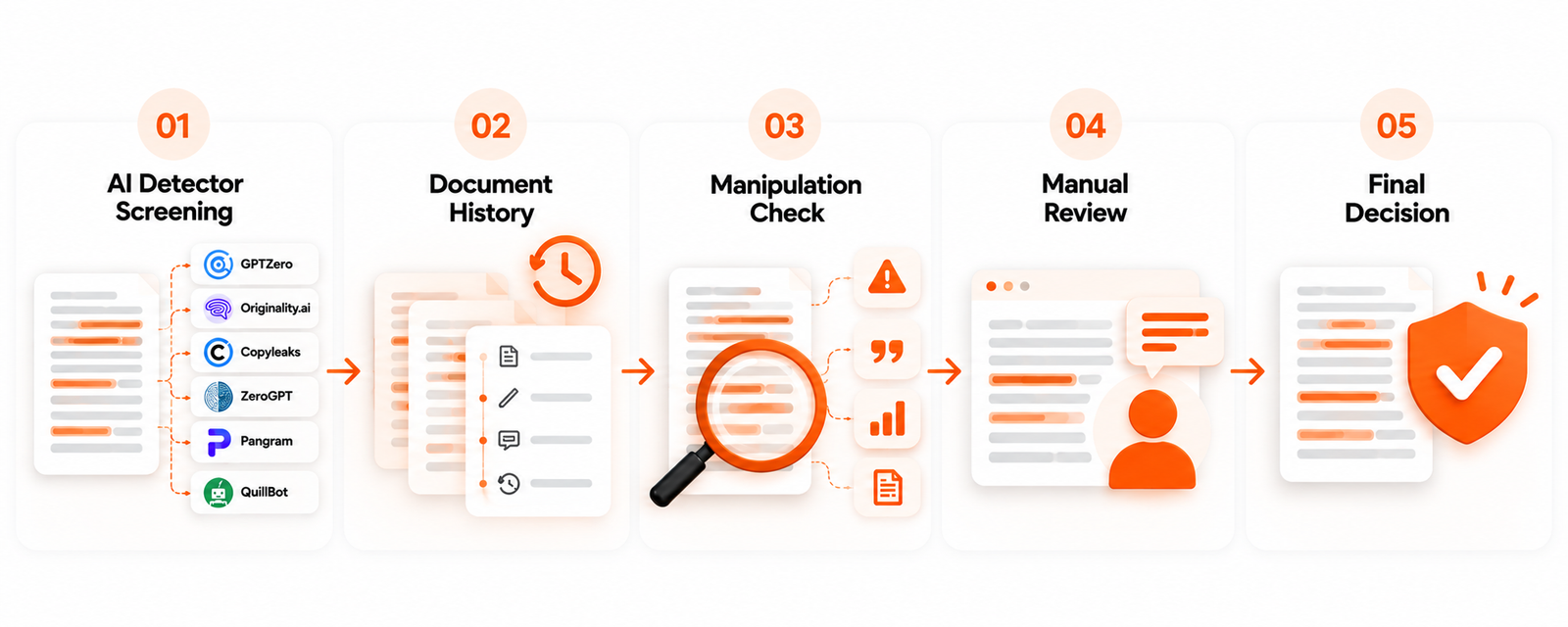
To check AI-generated content more precisely, Clicksy employs a general roadmap for content that includes the following stages:
- AI detector screening.
- Writing history analysis.
- Identifying content manipulations.
- Manual review.
- Final verdict.
We employ a combined strategy for checking AI content and strive to find the optimal verification model for each case.
AI Detector Screening
To ensure reliable results, we run several checks using different AI detectors. We prioritize trusted solutions, such as GPTZero and Originality.ai. However, our choice may differ depending on the domain, article length, and language.
We are aware of high false positive scores for non-native speakers. We attribute this problem to writers’ limited choice of lexical and stylistic devices, which is often flagged by most AI detectors. In these cases, we insist on checking with at least two or three detectors and reviewing the version history, drafts, and related resources.
Document History Analysis
Google Docs and Revision History are ideal for this stage because they allow us to track the entire story of the writing. Clicksy editors examine the corrections and trace the edit patterns. We search for gradual completion to prove that the text is human-written. The clearest sign of AI generation for us is simply pasting the entire text into the document.
Identifying Manipulation Attempts
Then, we employ our proprietary technique to spot AI-written content through the possible use of auto-typing tools and humanizers. Common signs of such manipulations include unnatural repetitions, forced idioms, and intentional errors. Vocabulary mismatches with the topic, genre, and style of the text are also a distinct feature.
Manual Editorial Review
After using AI detectors, human editors start reading the actual work and comparing it with the author’s previous submissions. To check AI-generated content, Clicksy experts particularly check the writing for formulaic structures, evaluate the document’s level of expertise, and assess factual depth.
While accepting only fully human-written content, we allow AI for simplifying and speeding up preparation and self-checks while writing. However, these practices have to be complemented by additional human checks and research.
Final Decision
For a verdict, we sum up all signals. Accepted thresholds vary by content type and by the checker applied. The most common threshold is below 15%, but some YMYL texts may allow only up to 5%.
If the AI score is good but the article has other types of drawbacks, we request corrections. Possible issues include low uniqueness, numerous grammatical and stylistic errors, absence of substantive content and similar issues.
Frequently Asked Questions
What Is AI-Generated Content?
The term refers to any media materials, created by artificial intelligence. The Western world uses the term “AI-generated content,” while “AIGC” is widely used in Asia-Pacific.
Are There Methods for 100% Accurate AI Detection?
No, all AI checkers admit their limitations and claim an accuracy of up to 99% at best. Such a high percentage is possible for fully AI-generated content. However, the effectiveness of checking drops for mixed and humanized content.
What Do AI Checkers Look for While Scanning Text for LLM Generation?
AI content detectors work by analyzing a text’s burstiness, perplexity, and stylometry. That is, they evaluate the sentence structure variation, language predictability, text’s vocabulary and language patterns, respectively.
What Are AI-Generated Content Watermarks?
Some generative models, such as SynthID, embed text with specific watermarks. They cannot be removed manually. Possible solutions include heavy paraphrasing and back-translation. However, their effectiveness is diminishing with updates to C2PA.
Want Better Content and SEO Results?
Good content is only part of the job. It also needs to reach the right audience. Explore our content writing services , see how we approach SEO in our case studies , or get in touch to discuss your project.